

One year ago this coming week, on 11 April 2011, France became the first European country to ban the wearing of the burqa and the niqab in public. While the language of the law was religiously neutral--«Nul ne peut, dans l’espace public, porter une tenue destinée à dissimuler son visage»--it was well understood, amid protests and plaudits, that the primary target of the legislation was the face-obscuring habilements of Muslim women. The French government portrayed the move as a necessary identity measure for public safety, despite the fairly small number of women affected (estimated at 2,000 and perhaps far fewer of France's nearly five million Muslims) and despite the fact that plans for enforcement, while fairly sensitive and humane, belied the ostensible danger that prompted the ban. The deeper impetus for the legislation appeared to be creation of what its supporters viewed as a bulwark protecting the public sphere in France from extremism and inequality. Opponents, in contrast, saw an unnecessarily intrusive government encroachment on a fundamental human right.
One of the more visible recent clashes addressing the question of the Islamic identity in Europe, this conflict and controversy raises the more haunting question of the ability and willingness of Europe to make good on its commitment to human rights when dealing with its Muslim inhabitants and neighbors. An inevitable focal point for these inquiries is the European Court of Human Rights and its judgments dealing with Muslim issues. Are the remedies available under the key European human rights instruments—most notably under the European Convention for the Protection of Human Rights and Fundamental Freedoms, but more recently also under the European Union's Charter of Fundamental Rights, as effective for those whose beliefs, culture, and identities are rooted in Islam as they are for other inhabitants of Europe?
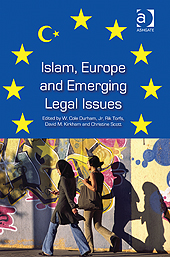
Islam, Europe and Emerging Legal Issues, a new book written and edited by supporters of the Strasbourg Consortium, takes aim at precisely these issues. Edited by W. Cole Durham, Jr., Rik Torfs, David Kirkham, and Christine Scott and published by Ashgate Publishers, the book explores the key Islamic cases to appear before the European Court in the past decade and assesses with honesty and sympathy the background questions surrounding the wearing of the Islamic veil.
For an analysis of additional social norms and developments regarding European Islam, e.g., education, finance, security, as well as selected country case studies, watch also for the book’s successor, Europe and Political-Cultural Islam, again from Ashgate, to appear later this year.
David Kirkham